Dope Status!!



Hello
Joined: Jul 2007
Posts: 2,150
Likes: 0
From: Va Beach


 Re: Dope Status!!
Anyone you know actually sneak in a modern VW? I know a few who swapped pans on old air-cooleds but this would be super dope. Love the ext-cab.
Oh and I'm still trying to get dude to snap better shots of his fenders. Fucker's being retarded though...

re: http://dl.dropbox.com/u/2416530/au/p...e_GXPCoupe.jpg

http://igor113.livejournal.com/51213.html
Oh and I'm still trying to get dude to snap better shots of his fenders. Fucker's being retarded though...
re: http://dl.dropbox.com/u/2416530/au/p...e_GXPCoupe.jpg
http://igor113.livejournal.com/51213.html

Boner Jams
Joined: Feb 2003
Posts: 7,227
Likes: 0
From: Dirty ass kempsville
Re: Dope Status!!
That thing is dope. I had to google what it was.
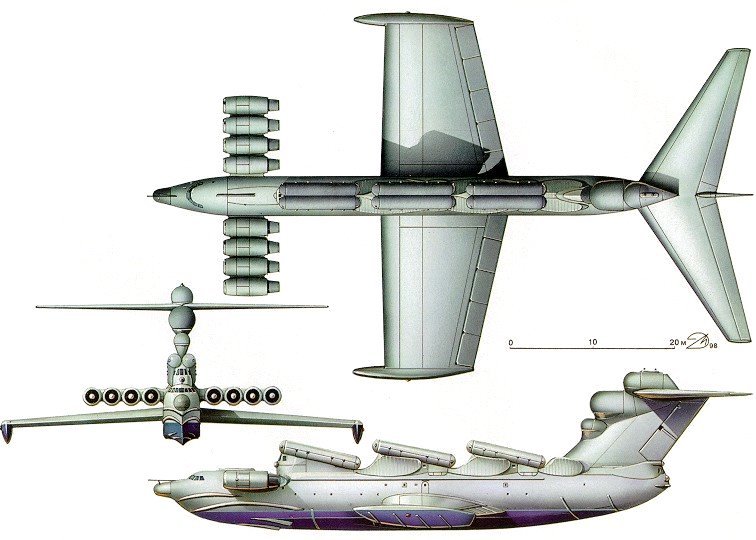
The Lun-class ekranoplan Ground effect vehicle ("harrier"; NATO reporting name Duck) was an unusual aircraft designed by Rostislav Evgenievich Alexeev and used by the Soviet & Russian navies from 1987 to sometime in the late '90s. Ground effect aircraft use the extra lift of their large wings when in proximity to the surface (about one to four meters). It is one of the largest ever built, with a length of 73m, rivaling the Hughes H-4 Hercules ("Spruce Goose") and many modern jumbo jets.
The sole vessel of her class, MD-160 entered service with the Black Sea Fleet in 1987. Eight Kuznetsov NK-87 turbofans were mounted on forward canards, each delivering 127.4 kN (28,600 lbf) of thrust. MD-160 had a flying boat-like hull with a large deflecting plate at the bottom of the hull to provide a "step" for takeoff.
The aircraft was equipped for anti-surface warfare, carrying the P-270 Moskit missile. It was fitted with six missile launchers, mounted in pairs on the dorsal surface of the fuselage, and advanced tracking systems mounted in the nose and tail. A development of the Lun was planned for use as a mobile field hospital for rapid deployment to any ocean or coastal location. Work was 90% complete on this model, the Spasatel, but military funding ceased and it was never completed. The sole MD-160 is now unused at a naval station in the town of Kaspiysk.
The sole vessel of her class, MD-160 entered service with the Black Sea Fleet in 1987. Eight Kuznetsov NK-87 turbofans were mounted on forward canards, each delivering 127.4 kN (28,600 lbf) of thrust. MD-160 had a flying boat-like hull with a large deflecting plate at the bottom of the hull to provide a "step" for takeoff.
The aircraft was equipped for anti-surface warfare, carrying the P-270 Moskit missile. It was fitted with six missile launchers, mounted in pairs on the dorsal surface of the fuselage, and advanced tracking systems mounted in the nose and tail. A development of the Lun was planned for use as a mobile field hospital for rapid deployment to any ocean or coastal location. Work was 90% complete on this model, the Spasatel, but military funding ceased and it was never completed. The sole MD-160 is now unused at a naval station in the town of Kaspiysk.
During the Cold War, ekranoplans were sighted for years on the Caspian Sea as huge, fast-moving objects. The name Caspian Sea Monster was given by US intelligence operatives who had spotted the huge vehicle, which looked like an airplane with the outer halves of the wings removed. After the end of the Cold War, the "monster" was revealed to be one of several Soviet military designs meant to fly only a few meters above water, saving energy and staying below enemy radar.
Last edited by -Danimal; Jan 27, 2011 at 10:11 AM.


Registered Member
Joined: Jun 2010
Posts: 324
Likes: 0
From: nowhere fun
Re: Dope Status!!
guess I wasn't the only one inspired to do some digging. Here's what I found:
In 1987 the "Lun" was launched on water, the first ship of a series battle missile ekranoplanes (length: 242-ft, span: 144-ft 4-in, weight 882,000-lb). The main designer was V.Kirillovykh. The ship was armed by three pairs of cruise missile 3M80 or 80M "Mosquito" (NATO's designation SS-N-22 Sunburn).
Maximum speed, km/h 500 (=350 mph)
Range, km 2000 (= +/- 1200miles)
In 1987 the "Lun" was launched on water, the first ship of a series battle missile ekranoplanes (length: 242-ft, span: 144-ft 4-in, weight 882,000-lb). The main designer was V.Kirillovykh. The ship was armed by three pairs of cruise missile 3M80 or 80M "Mosquito" (NATO's designation SS-N-22 Sunburn).
Maximum speed, km/h 500 (=350 mph)
Range, km 2000 (= +/- 1200miles)
Last edited by Str33tr; Jan 27, 2011 at 10:50 AM.